
The Future of Secure Drone Ecosystems: Why Agriculture, Data, and Trust Must Fly Together

A Drone Once Flew Away with the Data
It didn’t crash.
It didn’t fall into a field.
It didn’t even send a warning.
The drone simply kept flying.
What was meant to be a routine agricultural mission turned into a silent failure. The pilot watched his controller insist everything was “connected,” while the drone had already stopped listening.
By the time the battery gave up, the drone was gone.
Along with it went high-resolution crop imagery, GPS-tagged spray data, and weeks of planning.
The loss wasn’t just hardware. It was trust.
That incident forced a hard reset in our PDRL. We stopped treating drones as isolated machines and started designing every release around system-level guarantees—secure flight controller, trusted positioning, validated mission planning, and auditable cloud workflows.
The goal was simple:
this should never happen again, at any stage of deployment.
Why This Story Matters Today
Drones are no longer experimental tools or hobby devices.
They are now actively used for:
- Precision agriculture and spraying
- Crop health monitoring
- Infrastructure inspection
- Urban planning
- Disaster response
Yet most drone failures today don’t happen because drones can’t fly.
They happen because the ecosystem around the drone is fragmented, insecure, or poorly designed.
This is where the future of secure drone ecosystems truly begins.
What Is a Drone Ecosystem (And Why the Drone Is the Smallest Part)
When people hear “drone technology,” they usually imagine propellers, batteries, and cameras.
In reality, the drone itself is only one component in a much larger system.
A drone ecosystem includes everything that happens before takeoff and long after landing, such as:
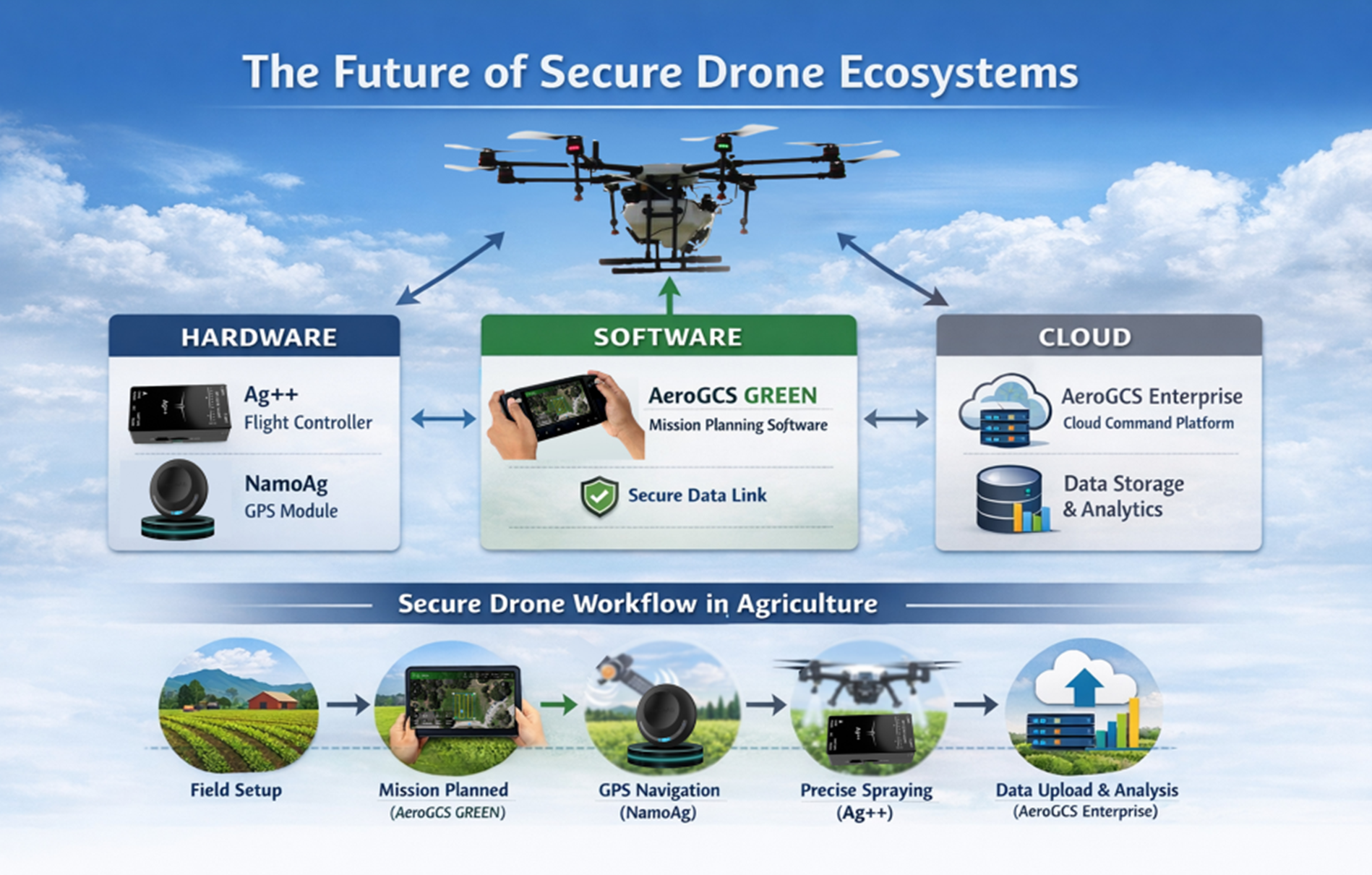
- Hardware: flight controllers, sensors, GPS, communication modules
- Software: mission planning, firmware, analytics
- Cloud platforms: storage, processing, access control, reporting
- Security layers: encryption, identity, compliance
- Human workflows: pilots, managers, auditors, clients
When these pieces operate independently, drones remain fragile tools.
When they are integrated securely, drones become reliable infrastructure.
Why Security Is No Longer Optional in Drone Operations
Every modern drone flight generates sensitive data:
- High-resolution imagery
- Exact geographic locations
- Time-stamped activity logs
- Operational and financial insights
An insecure drone ecosystem risks:
- Data leaks and IP theft
- GPS spoofing and flight hijacking
- Manipulated analytics and false reports
- Regulatory violations
- Long-term loss of customer trust
Security is no longer a feature you add later.
It is the foundation that enables scale, compliance, and credibility.
Inside a Secure Drone Ecosystem
Hardware: Where Trust Begins
Security starts in the air.
A trusted drone ecosystem relies on hardened hardware components that behave predictably under all conditions.
In real deployments, systems like Ag++ function as secure flight controllers, enforcing flight logic, safety constraints, and fail-safe behavior. Navigation integrity is strengthened using trusted positioning solutions such as NamoAg GPS, reducing drift, spoofing, and false coverage claims.
When flight controller and positioning are built on trusted hardware, the drone follows intent—not improvisation.
If this layer is compromised, no amount of cloud security can fix it.
On-Device Software: The Drone’s Brain
Onboard software decides how a drone behaves when conditions change.
Secure drone software ensures:
- Missions are validated before execution
- Geo-fencing and no-fly zones are enforced
- Telemetry and commands are encrypted
- Safe behavior during signal loss
- Updates are authenticated and controlled
A mature ecosystem guarantees that even when a drone loses connectivity, it remains compliant and predictable.
Mission Planning and Ground Control: Where Humans Interact
Most operational failures happen at the human interface.
Mission planning tools must balance simplicity for pilots with control for organizations.
Platforms like AeroGCS GREEN represent this balance well. Instead of merely drawing flight paths, mission planning becomes a structured process where altitude limits, spray widths, boundaries, and permissions are validated before takeoff.
Good design ensures pilots don’t need to think about security—it’s already built into the workflow.
Ease of use is not the enemy of security. Poor design is!
Cloud Platforms: Turning Flights into Decisions
The cloud is where drone data becomes useful.
Enterprise platforms such as AeroGCS Enterprise, delivered as secure cloud web applications, allow organizations to:
- Ingest data securely from the field
- Store imagery and telemetry with full traceability
- Run processing pipelines for maps, analytics, and AI
- Maintain audit trails and access logs
- Generate reports that stand up to scrutiny
This layer is where operational trust is either earned or lost.
A Real Deployment Scenario: Secure Agriculture in Practice
Consider a large farming cooperative running drone-based spraying across hundreds of acres.
Each day begins with a predefined mission.
- Ag++ governs the drone’s flight behavior, ensuring altitude, speed, and spray logic cannot be altered mid-flight.
- NamoAg GPS provides accurate positioning, minimizing drift and preventing false acreage claims.
- The mission is planned in AeroGCS GREEN, where boundaries, spray width, and no-fly zones are validated before takeoff.
As the drone operates, telemetry and spray data stream securely to the cloud.
Back at the office, managers log into AeroGCS Enterprise to:
- Verify actual area coverage
- Compare planned versus executed missions
- Generate transparent billing reports
- Resolve disputes without manual logs or guesswork
No assumptions.
No trust gaps.
No “pilot says one acre, system says another.”
The ecosystem enforces truth—automatically.
Does Security Slow Down Drone Operations?
This is one of the biggest misconceptions in the industry.
In practice, insecure systems:
- Cause repeated flights
- Lead to billing disputes
- Require manual verification
- Break client trust
A secure drone ecosystem actually:
- Reduces rework
- Automates compliance
- Speeds up decision-making
- Enables operations at scale
Security doesn’t slow teams down.
It prevents them from going backwards.
Ease of Use: The Hidden Success Factor
If security feels heavy, users will bypass it.
The future belongs to drone ecosystems that:
- Hide complexity behind clean interfaces
- Automate security by default
- Require minimal pilot training
- Produce explainable, auditable outputs
The best security systems are the ones users barely notice—but always rely on.
Why the Future Depends on Secure Drone Ecosystems
Drones are becoming:
- Agricultural infrastructure
- Urban intelligence platforms
- Emergency response systems
- Inspection and logistics networks
As scale increases, risk multiplies.
The future will favor drone ecosystems that are:
- Secure by design
- Cloud-native
- AI-integrated
- Regulation-aware
- Human-centric
The Core Question Behind Every Scalable Drone System
The question is no longer:
“Can our drones fly?”
The real question is:
“Can we trust the data, decisions, and systems behind every flight?”
Those who build secure drone ecosystems won’t just operate drones.
They will define how the world uses aerial intelligence.